Finding the Art in Everything


Showing posts with label criticism. Show all posts

18 February, 2013

Around & about

It's president's day. And if you're one of those people (like me) stuck at work when the rest of your people are presidentially enjoying their day off, you might want for something to read.

If you are bumming around today, read these. It's a good way to spend some time off.

  • It turns out the Vatican was also contemplating Amy Winehouse.
  • Jason Morehead asks great questions about The Persecution Complex of the Modern Introvert.
  • 10 Lists That Read Like Poems 
    • I already have a psychotic compulsion for making lists. I now want to make a list in each category, especially one like Nora Ephron's and Isaac Newton's. Or I wonder if I'd get hired by making Da Vinci's list into a resume for myself.
  • Then I also found Thelonius Monk's awesome list of advice, reminding me he was as much philosopher as he was musician. How to be cool and be good and all that jazz.
  •  "The tremendous activity of a boy sitting still." The Fine Arts Museum of St. Petersburg, FL had a strong collection of Ashcan Art- paintings from early 20th cent. urban and immigrant life. I thought it was some of the best art I found in Florida.  These works are powerful and real. They make the Impressionists look like they drowned in their damned waterlily ponds. Read this great discussion of what they meant to America and art here.
    • Excerpt: ""People's houses," Robert Henri wrote, "get to look like them. There is more in a house than the materials it is made of. Humanize the house." The Ashcan School painters took this very seriously, finding ways to humanize nearly everything. In George Luks' 1908 painting, “The Guitar (a Portrait of the Artist's Brother with His Son),” a guitar is shown to be a tool by which the father will teach the infant son how to become a man. The guitar is an outgrowth of the father's character as it is being imprinted on the baby boy."
  • I am on the hunt for a used copy of Joan Didion's Slouching Toward Bethlehem. I keep seeing it quoted and used about life in California. I live in California. I love California.  I want to write like Joan Didion. So I must read this classic book. It also needs to be a real copy. It won't be as real as she is if I yank it out of an Amazon package and crack the spiffy new spine myself.. If you're browsing second hand shops, and you see one of these, pick it up for me. Until then, read this great interview with her from Believer Magazine.
  • Have I mentioned lately that I love where I live? Look what's happening in a couple of weeks to the Bay Bridge--a bridge I try not to cross because it takes me to the wrong side of the bay (Oakland is NOT for me), but still!  How awesome will this be?
  • Maybe I would have been more athletic if I had known Scientists suggest beer after a workout.
  • Remember when I said that going to bars and seeing friends' bands was one of my favorite things to do? Some of those those guys from those bars in my twenties are still at it. Look. I even have a t-shirt with the lead singer on it.
  • .Making Art With 60,000 Woven Coffee Stirrers What a glorious use for them! Hooray for physics and art!

08 February, 2013

More Wonderings & Wanderings

I sent my friend a link to an article on Salon.com. And then I sent her another one, "because it appears today I'm trolling around Salon." She said, "it's fun to see what blog or site you get caught up in by the flurry of "read this!" links posted in various places."

In case I wasn't all up in YOUR feed, here are some things I've enjoyed. 

  • Mark Driscoll and the conversation about him are hardly strangers to polar opinions. The promotion of his new book stirred the usual hornet's nests. Christianity and Pop Culture and an interesting comment on it all, though: 
    • "We don’t need another post on Mark Driscoll, either for or against. We don’t need to talk about the moral implications of giving away prizes for favorable book reviews, or about detractors that are cruel in their critiques. What we need to talk about are the ways we as Christians need to get off the merry-go-round of vitriol in dialogue, of responding to every mini- and mega-theology debate that appears on our Twitter and Facebook feeds. There is quite enough of this going on." The poor guy then had to actually ask that people who tried to win his ipad giveaway please read the book first.
  • By Heart is a series in which authors share and discuss their all-time favorite passages in literature.  Rosie Schapp, author of Drinking with Men, reflects on her relationship with William Blake: 
    • "But in a quietly perceptible way, my experience of grief shifted, as though the passage told me to live in that grief as long as I might need, that—through memories, through love, through the very impulse to grieve—it was entwined with joy; that stitched somewhere in my sadness—which seemed insurmountable—was a thread of happiness. This time, Blake did not save my life. Instead, he lit a little votive in the small, dark chapel of loss, by whose light I started to see a way through."
  •   Preston Yancey blogs about women's voice in church. I have been really struggling with my place in the church and our church lately, discouraged by the unchallenged status quo of microphones for men only. I'm not demanding a microphone, but I am weary of never hearing a voice that sounds like mine. I loved this line:  "I forget that it still seems strange for some to say that what should be at issue is calling not gender and that the Holy Ghost is awfully fond of surprising us and overturning our paradigms."
And the Salon articles that started the morning's wanderings,
  • Google Internet Cache—the Roman ruins of the 21st Century. Jacob Savage waxes nostalgic about coming of age the same time the internet did.
  • The baker’s lament ; As a pastry chef, I watched my artwork vanish in seconds. But its ephemerality was also what made it beautiful. 

22 June, 2010

C is for Culture

5And he that sat upon the throne said, Behold, I make all things new. And he said unto me, Write: for these words are true and faithful. Revelation 21:5 (KJV)

8 Finally, brethren, whatever things are true, whatever things are noble, whatever things are just, whatever things are pure, whatever things are lovely, whatever things are of good report, if there is any virtue and if there is anything praiseworthy—meditate on these things.
Philippians 4:8 (New King James Version)


C is for Culture.

One of my heartaches regarding Central Florida is the lack of culture here. As an English Literature major an amateur musician and Art History teacher, I live for it. When I first moved here, one of my coworkers tried to convince me there was culture, but I just had to get used to the local kind. Anyone passing through Daytona can see the temple to what he's talking about--it can hold half a million people who live to watch people drive in circles, really fast. No. That is not culture.

Culture is NOT shirtless overall-wearin', gin-jug totin', toothless gator-shooters celebrating their lawn trash.

Yet, culture is NOT the high-minded post-modern celebration of human depravity such as Chris Ofili's The Holy Virgin Mary a collage of Mary incorporating cut-outs from pornographic magazines and shellacked clumps of elephant dung. Art is often tasked with raising controversy, but in every literal way, this is just shit.

And still, culture is NOT, as Franky Schaeffer writes in Addicted to Mediocrity, * (and as a recovering Christian-retail worker, I love this list, so here's the whole thing!) "the contents of your local Christian bookstore-accessories-paraphernalia shop:

For the coffee table, we have a set of praying hands made out of some pressed muck. Christian posters are ready to adorn your walls with suitable graffiti to sanctify them and justify the expense... Perhaps a little plastic cube with a mustard seed entombed to boost your understanding of faith... And if this were not enough, there's a toothbrush with a bible verse stamped on the plastic handle... And a comb with a Christian slogan or two impressed on it.

...On a flimsy rack are stacked a pile of records. You may choose one at random, blindfolded, for most of them will be the same idle rehash of acceptable spiritual themes, endlessly recycled as pablum for the tone-deaf, television-softened brains of present-day Christians...

...And finally, the publishing houses churn out (measured by the ton) a landslide of material which can scarcely be called books, often composed of the same themes which are viewed as spiritual, slopped together by 'writers' who would be better employed in another trade."


For rednecks, post-moderns, and especially Christians, it is crucial for the redemption of all things that we find true culture.

So if it isn't any of this, what is it?

Matthew Arnold, an English Victorian poet, social-reformer, and critic defined in his book Culture and Anarchy, "Culture is, or ought to be the study and pursuit of perfection; perfection of beauty and intelligence, where Sweetness and Light are the main characters."

Arnold goes on to argue that only culture of this kind has the power to shape a society--to correct the worst effect of laissez-faire capitalism among social classes, the neglect of the common good. With a collective celebration of Intellect and Beauty for their own sakes, people would be reminded what was good and so be motivated to strive for it.


Arnold was talking about culture chiefly for pseudo-political purposes, the stabilization of a turbulent British society. I think he has the right definition of it, a correct assessment of its power, but aiming toward the wrong end.


Instead, Christians should be working within culture to redeem it and use the best of it to point people back toward the Source of all good things. Christians should break down the sacred-secular divide with their participation in and celebration of all things excellent.

Our post-modern society is marked by individualism and its only end is man's right to do as he pleases for himself. We need something more powerful than that if we are going to make a transforming difference.

Beauty and Intellect are the meeting point between this kingdom where man is god and the Kingdom of God as described by the Gospel.

The beginning of this celebration of intellect and beauty, Sweetness and Light, is marked by the Hellenistic Golden Age in Greece. Greek humanism held intellect and beauty as its highest virtues. We need Christians to be nourished by this tradition of humanism, without being Humanists. As Christians, we know man is not the measure of all things, the Son of Man is.

All things will be made new. God's kingdom will reverse this world's momentum of decay. People, nature, politics, art, relationships--all of it-- will be redeemed.

Christians have an immediate role to play in this redemption: We must use the Truth we have to stop the best of this world from spoiling, not be content with the mediocre. The Gospel deserves the highest creativity and human expression we can muster, and we must use the high accomplishments of creativity and expression as pathways to the Gospel.

We are called to be the Salt and Light, after all. Let's get to work.


*Addicted to Mediocrity was written 25 years ago. Since then, it's important to fairly note the strides Christians have made in music and art--however small.

06 March, 2009

Imagism and Transubstantiation

I read some more of Pilgrim at Tinker Creek this morning. I'm 2/3 of the way through it. It's summer in the book, and there's been a devastating flood because of a tropical storm.

Even her most benign descriptions move me, and I hardly ever know why.

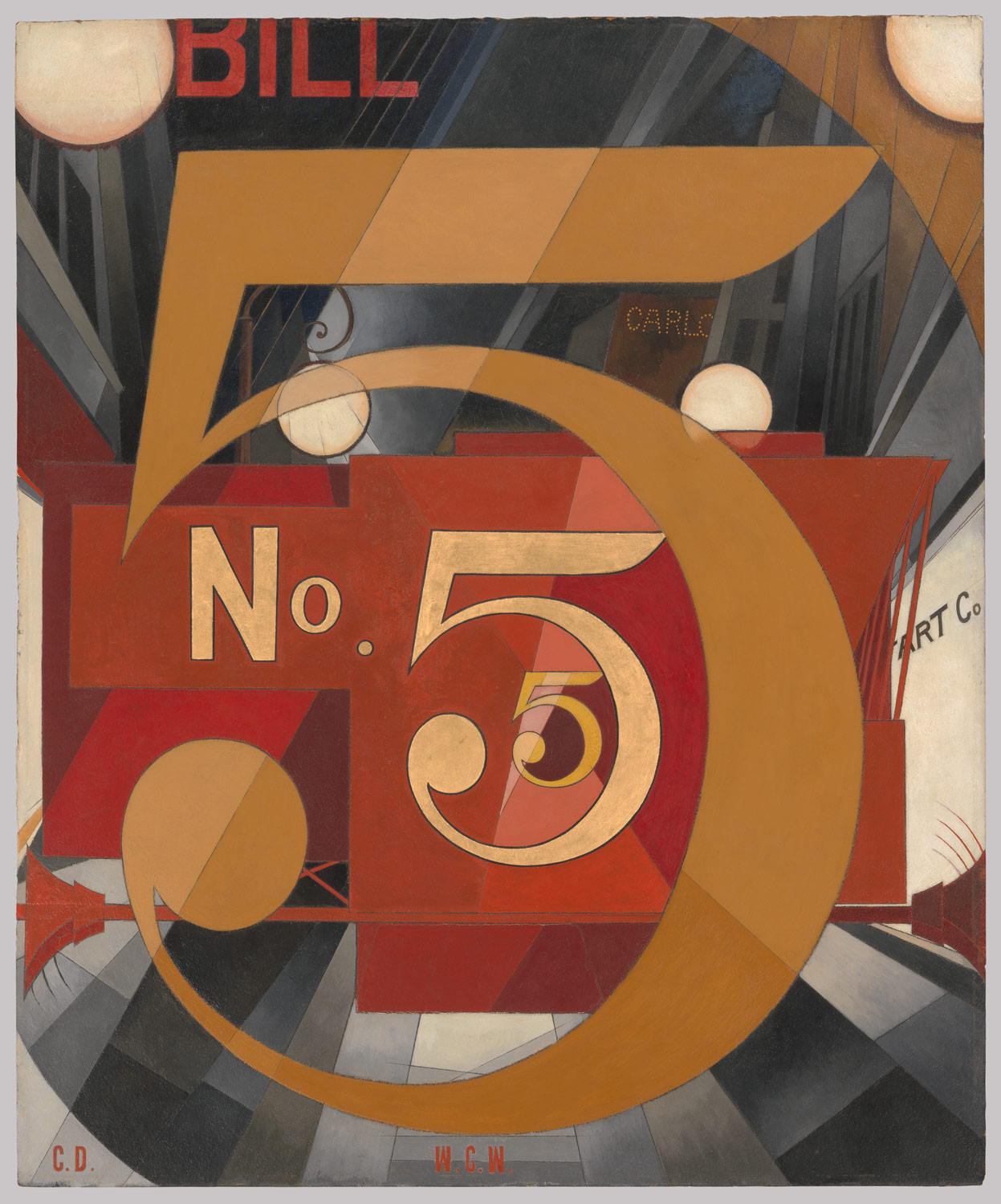
At the end of this week, we looked at the Art of Modernism in my AP Class: Hopper, Stieglitz, Okeefe, Demuth.

I showed Demuth's The Figure 5 in Gold and the corresponding poem by William Carlos Williams.

It reminded me how much I enjoyed the work I did in college on the Imagist poets, particularly Williams.

I love the aesthetics of vacillating between the literary line and the figurative one, and I'm fascinated by the emergence of meaning from the point where language meets visual perception. I think this is why I like Dillard so much: meaning emerges from the point where language meets biology and place--only with Dillard, the emergence is more of a transformation.

Her language does to nature what transubstantiation does to the bread and wine of the Eucharist.

08 August, 2008

MFA St. Petersburg Highlights

Today my friend Anna and I finally made it to the Museum of Fine Arts in St. Petersburg, FL. It is said to be the best art gallery we have here in Florida, which isn't saying much for a theme park state. Still, the gallery boasts more than a decent cast of characters. This is my first time visiting it since their renovation and since my brief teaching foray into "art history," and both of these things made me enjoy it so much more than my last time here.

Gallery Highlights:

  • It's not ever crowded. No one is in your picture viewing space.

  • It is small, it can be thoroughly seen in a little under 2 hours.

  • Excellent, thorough curating. What makes this gallery affordable and accessible is that there are no real masterpieces in it, which is how we probably have it in Florida. Even though it is full of second and third-tier works, the explanations on the wall accompanying the work note its all its meaningful aspects AND situate the artist within the movement of its contemporaries. THEN it explains the movement and its characteristics, THEN it identifies aspects of the work that match both characteristics of the artist and movement. This approach taught novices and experts alike, while truly revealing the nature and significance of the work. I couldn't find who wrote them, but well done! to them.

  • The Ansel Adams and the American West exhibit. I have seen hundreds of reproductions of his prints but never so many made by the artist himself. The exhibit showcased 2 schools of photography. The first, founded by Adams in his club F/64, produces its its image with straight photography with little or no manipulation of contrast during printing. The other school is the pictorialist one, where images are refined and abstracted during printing and the artists' visions are revealed in the darkroom. My dad belongs to the straight photography school, who uses his engineer's penchant for math and science to shoot the exact image he wants. For me, the math and science of shooting pictures is a means to an artistic end, where my main care is in the composition of line and shape, color and form. I think I'm more Stieglitz than Adams.

  • Leon Berkowitz's Big Blue. This piece made me remember why I give any time to color field paintings. Seeing the paintings reproduced they look more like colorful geometry. Seeing them in person reveals their movement. The light and colors vibrate and play off each other. It is not that the work doesn't have any subject, it is just that it's seeking to almost objectify the abstractions of movement, energy, color, and light.


  • The lesser known pieces of the Ashcan artists. The Ashcan school was famous for its gritty urban life scenes at the turn of the 20th century. This trio here features surprising contemplation and serenity. the SPMFA has several of these kinds of lesser-known pieces that complete the viewers collective understanding of the artist. By showing these atypical pieces, the artists become more than their reputations, schools, and stigmas.


  • The American Impressionists. This is an impressionist painting of a place in Massachusetts. I love to see American examples of American things because it keeps the art I love from feeling so foreign. Impressionism does not have to be inherently tied to french nationalism.


  • The Shepherd Girl by Bouguereau. His people seem to be living, and although is this a miniture of the first version, (still painted by the original artist) it is just as moving. Bouguereau was a French Academic painter and one of the most admired critics of the 19th century. It is nice to see someone still painting in the lines during this time, and beautifully at that, rather than drowning in either absinthe or the silly lilly pond.

10 April, 2008

On Neighbors

A sage friend of mine has done a series of posts this week on Thoreau, and before commenting, I want to express my gratitude.

Not raised with a profound appreciation for the Transcendentalists (they're clever phrase-turners but wacky, self-absorbed, impractical men), I am always so delighted when someone reminds me of how good they are. I have a friend, who, for years has championed Emerson, especially his early discussions of prayer, and now I work with someone whose (invisible) daily t-shirt reads "I'd rather be at Walden." It's not only my sage friend's contemplative posts for which I am grateful, but his commitment to pursuing what is Good--and what makes him Good.

He says, " I read one of Dan Brown's books over the Christmas break--Angels and Demons. And I'll say about it what I said after reading The DaVinci Code: Dan Brown is good with suspense and plot, but he's not much of a craftsman when it comes to prose. But now, I want to add this: Did reading either of these books improve my life in any way? Did they inspire me to greatness? Did they show me any truth about my life, or about the human condition? Did they help me to understand anything about myself and my relationship to the world?

Of course, the answer to all of these questions is no.

And of course, the answer to this problem is to choose your friends wisely, and to spend time (and effort) developing the relationships in your life that matter."

I had a conversation with my little sister tonight about why we don't watch / listen to / read junk. She had tried to show me a YouTube video with a parody song for "Snakes on a Plane." It came from my brother who watches an enormous amount of TV, has only ever read 4 books, and listens to everything; sometimes it seems his only criterion is "The coarser the better." I resent his ability to mold my sister into his likeness--a poster-child for Thoreau's "underbred and low-lived and illiterate..."

With my sister, I am free to speak in terms of a common faith that I don't really share with my brother. At fifteen, she possesses a passion for truth, a desire to know God, and a human compassion that belies her age. That she might become mired in YouTube (at best) poses and urgent crisis--one that makes me examine my drive to "find the art in everything." With Megan, I could easily say, "We avoid this stuff because God tells us to," and her concern for living rightly wouldn't need much more of an explanation. But she deserves more than that--we both do--as YouTube and "Will.I.Am" threaten to devour her.

I think about giving her Thoreau, but I remember I have something a little more meaningful. While I am so pleased by the excerpt from Thoreau that reminds me how to live rightly, I forgot I already had excerpts that practically teach us to do this.

We pursue Homer, Michelangelo, Madison (Federalist Papers), and Haydn because we are directed to:

St. Paul urges the Philippians, "Finally, brothers, whatever is true, whatever is noble, whatever is right, whatever is pure, whatever is lovely, whatever is admirable—if anything is excellent or praiseworthy—think about such things... And the God of peace will be with you."

Also, he urges the Thessalonians, "Test everything. Hold on to the good. Avoid every kind of evil."

While I put these verses in my brain in something like 5th grade, I only recently saw freedom and direction in them.I am stuck here at how relevant the specific passages of the bible are. (I probably wouldn't have been so startled by this, but I have spent the last 6 months or more wrestling with a paralyzing practical agnosticism worthy of a dozen posts.)

I was raised with a contempt for the Trancendentalists because their humanism and "Oversoul" theology is out of line with my God-centered, spiritually specific one. But I need to read Plato. I need to read Madison. I need to read Donne and Dostoyevsky. I need to read these because they are right and noble and excellent, even if we aren't in perfect agreement. Thoreau's pursuit of meaningful neighbors is meaningful to me.

Here is what startled me: I am meant to be, by tradition and habit, odds with Thoreau, while the Thoreauvians are at even greater odds with traditional Christian teachings. Yet, they match!

I am free to read everything and only keep what is good. And I am not just free, I am required to. Herein lies an even great direction for living rightly.

Shortly before Jesus is crucified, he fervently prays for his disciples in the upper room, "My prayer is not that you take them out of the world but that you protect them from the evil one. They are not of the world, even as I am not of it. Sanctify them by the truth; your word is truth. As you sent me into the world, I have sent them into the world. For them I sanctify myself, that they too may be truly sanctified."

Those who follow Christ are meant to be in the world, but not of it--quite the familiar Christian phrase.

It is in pursuit of this ideal--being in the world but not being a part of it-- that has us pursuing genuine touchstones of culture in order to guard against the toll taken by YouTube and Snakes on a Plane. We stay away from things that anchor us IN the world that are of it. We fill our lives with what is good because only this reflects the true nature of our God.

Those familiar with the directions of the Bible recognize that we follow them not because we fear judgment if we don't, but because they are what brings true life and peace.

Thoreau criticizes society because its complications and materialism do not bring life. This is not new to Christians, it is orthodoxy.

And this leaves the distinct possibility that the path to sanctification is through Walden's woods.

17 March, 2008

The Parable of the Talents

14"Again, it will be like a man going on a journey, who called his servants and entrusted his property to them. 15To one he gave five talents[a] of money, to another two talents, and to another one talent, each according to his ability. Then he went on his journey. 16The man who had received the five talents went at once and put his money to work and gained five more. 17So also, the one with the two talents gained two more. 18But the man who had received the one talent went off, dug a hole in the ground and hid his master's money.

19"After a long time the master of those servants returned and settled accounts with them. 20The man who had received the five talents brought the other five. 'Master,' he said, 'you entrusted me with five talents. See, I have gained five more.'

21"His master replied, 'Well done, good and faithful servant! You have been faithful with a few things; I will put you in charge of many things. Come and share your master's happiness!'

22"The man with the two talents also came. 'Master,' he said, 'you entrusted me with two talents; see, I have gained two more.'

23"His master replied, 'Well done, good and faithful servant! You have been faithful with a few things; I will put you in charge of many things. Come and share your master's happiness!'

24"Then the man who had received the one talent came. 'Master,' he said, 'I knew that you are a hard man, harvesting where you have not sown and gathering where you have not scattered seed. 25So I was afraid and went out and hid your talent in the ground. See, here is what belongs to you.'

26"His master replied, 'You wicked, lazy servant! So you knew that I harvest where I have not sown and gather where I have not scattered seed? 27Well then, you should have put my money on deposit with the bankers, so that when I returned I would have received it back with interest.

28" 'Take the talent from him and give it to the one who has the ten talents. 29For everyone who has will be given more, and he will have an abundance. Whoever does not have, even what he has will be taken from him. 30And throw that worthless servant outside, into the darkness, where there will be weeping and gnashing of teeth.'

Footnotes: Matthew 25:15 A talent was worth more than a thousand dollars.

I am FURIOUS about the reaction of the so-called "AP kids" today.

  • I am NOT furious because another adult squandered a class to which I could have felt entitled.
  • I am NOT furious that preparation for this class and these kids which won't be used strongly dominated a much-needed break
  • I am NOT furious that the administration did not feel the same compulsion I do to beat students into being better versions of themselves.

I am FURIOUS because of the squandered talent. Those kids were given five "talents."

  1. They are given a second chance to redeem wasted time.
  2. They are given nearly one-on-one tutoring by a dedicated, qualified person.
  3. They are given every curricular advantage--even with the wasted time, what they have already actually used is double the national average
  4. They are given detailed instructions with crystal clear expectations and an endpoint to the work in sight
  5. They have the privilege of an administration who cares first for their success and makes special arrangements (at great expense) on the students' behalf.

These children did not just bury talents to be handed back. They threw them in the lake. It was not an unjust master they feared, it was the inconvenience.

I don't think the master's reaction is unjustified--the only way to address this cancer of character is to "throw that worthless servant outside, into the darkness, where there will be weeping and gnashing of teeth."

If only I could recommend that instead of "Demerits" on some official form.

22 December, 2007

Smashing the World

“The war creates no absolutely new situation: it simply aggravates the permanent human situation so that we can no longer ignore it. Human life has always lived on the edge of a precipice. Human culture has always had to exist under the shadow of something infinitely more important than itself…We are mistaken when we compare war to “normal life. Even those periods we think most tranquil…turn out, on closer inspection to be full of crises, alarms, difficulties, emergencies…” –C.S. Lewis (Weight of Glory)

“One of the most dangerous errors is [believing] that civilization is automatically bound to increase and spread. The lesson of history is the opposite; civilization is a rarity, attained with difficulty and easily lost. The normal state of humanity is barbarism, just as the normal surface of the planet is salt water. Land looms large in our imagination and civilization in history books, only because sea and savagery are to us less interesting.” C.S. Lewis (Rehabilitations)


The Washington Post, this past few weeks, has had several articles discussing the fight over the detention center at Guantánamo Bay, Cuba. I am deeply bothered by this whole situation, and I have been for some time. There has already been the congressional vote over the issue of the detainee’s treatment; now, it’s under judicial scrutiny, where the latest battle is over a destroyed set of tapes that allegedly recorded a significant interrogation. It is true that the issue of the Guantánamo Bay Detention center poses a serious political and ethical dilemma, but this governmental action is bringing us no closer to solving it. I question the legitimacy of a bill whose passage is so clearly marked by party lines, like this last one.

The more we talk about Guantánamo in terms of presidencies, bills, and hearings the smaller we make it. Few meaningful things actually fit in the tiny context of partisan politics. One problem with the Guantánamo situation is that it is being shoved into the role of a banner issue—one must be for or against it. But it doesn’t fit a context this small, and it is not the only issue that doesn’t. I feel the same way about abortion.

It seems to me the issue of Guantánamo shouldn’t be part of the referendum debate on the current administration, but part of one of the greater debates in human history: between civilization and. anarchy, or between war and pacifism. It is a great historical paradox that war—in all of its brutality and savagery—must be waged to protect civilization. War and civilization are intuitive opposites, except in the case of preservation. Lewis reminds us that shreds of civilization are hard won and not the normal state of humanity. The prisons in Guantánamo are an ugly reality of war—war on those who threaten our young notion of civilization.

We are fortunate that, in the last 100 years, our attempts to mitigate the hideous effects of war with conventions and treaties has been relatively effective. I don’t disagree that these conventions are a good thing—in fact, they still fight for civilization in the face of its opposition on the battlefield. But our biggest problem with Guantánamo and its detainees is that they may exist outside the battlefield defined by our rules and conventions. It may exist, as a friend helpfully identifies, in a space outside “democracy” and “rights” and even the law.

Of course I would prefer that we could keep war within the confines of our civilized political conventions; Of course I am appalled by the legal and physical conditions of Guantánamo , just as I would be appalled by these conditions in any other element of war. One argument (all superficial partisanship aside) is that a place such as Guantánamo seems absurd because it tramples democratic virtues. But maybe the absurdity is trying to apply civilized, democratic conventions to War in the first place. War and civilization are opposites. It is no wonder that the issue of Guantánamo is so problematic: the government is attempting to drag an element of war into an element of civilization, the United States Congress (where civilization is a broader term than that which evaluates the individual behavior of our representatives) The degree of political infighting does not reveal the magnitude of this issue’s significance, but the absurdity of pursuing a political solution.

A friend pointed out, “the decision to use methods of torture is not going to be definable by law… [W]e need to face the fact that there are some issues that cannot be solved for all cases in advance, and that this is one of them. The decision to torture someone is a moral decision, one about which one must have absolute certainty, and the Congress will not be able to define all of these cases via legislation.” The issue of Guantánamo is not threatening because it represents the work of an evil executive or military with too much power; it is threatening because it exposes the weaknesses and flaws modern liberalism and its political manifestations bear. Every age seeks to hold their own laws and systems as absolute, and the issue of Guantánamo , among others, exposes that principle for the historical hubris it is. Our notions of Civilization are actually young and fragile and perhaps sometimes flawed.

We don’t defend our system because it is perfect and everything about it is defensible. We defend it because this civilization is ours—a civilization, that Lewis defines as, “the realization of the human idea…the life of beings for whom the leisured activities of thought, art, literature, and conversation are the end, and the propagation of the species is merely the means…” (Rehabilitations) All patriotic pomp and circumstance aside, the 9/11 attacks put us directly at war with people who seek to destroy our political, economic, and moral system based on the freedom of choice. Their preferred system (if there is one) is one of totalitarian control by a few corrupt elite (using the government of Iran, as an example). We are free to be critical of this system—to in fact, deem it inferior—because we love our own.

Just because two systems both lay claim to the label of “civilized” does not make them equivalents. History reveals the tactics used by a Civilization to defend itself do not have to be civilized to be in defense of it. It is the brutality of war that masks a key difference between the two. While the elements of war are horrifying, we can make the distinction in the case of combative defense based on purpose: the purpose of preservation is inherently noble and civilized, while the purpose of destruction is not.

We may in 100 years, or even 10 years, come to regret our behavior in Guantánamo . But we would certainly regret not doing everything in our power to preserve our civilizations’ freedoms. As Chesterton points out, those who love the world would be “ready to smash the whole world for the sake of itself.”

15 December, 2007

The Flag of the World

There are those moments when you read something so catching that you wish everyone you know was also reading the same thing at that very moment. It is likely that no one else is reading that very thing because they care about it a great deal less than you, but blog-posting is sort of a half-way point between making people read your book and keeping it to yourself.

This morning, I came across some great Chesterton:

"For our titanic purposes of faith and revolution, what we need is not the cold acceptance of the world as compromise [between good and evil], but some way in which we can heartily hate and heartily love it... No one doubts that an ordinary man can get on in this world: but we demand not strength enough to get on with it, but strength enough to get it on. Can he hate it enough to change it, yet love it enough to think it worth changing? Can he look up at its collossal good without once feeling acquiescence? Can he look up at its collossal evil without once feeling despair? Can he, in short, be at once not only a pessimist and an optimist, but a fanatical pessimist and a fantical an optimist? Is he enough of a pagan to die for the world, and enough of a Christian to die to it? In this combination, I maintain, it is the rational optimist who fails and the irrational optimist who succeeds. He is ready to smash the whole world for the sake of itself."

and...

"An imbecile habit has arisen in the modern controversy of saying that such and such a creed can be held in once age but cannot be held in another...You might as well say of a view of the cosmos that it was suitable to half-past three, but not suitable to half-past four. [But] what a man can believe depends upon his philosophy, no upon the clock or the century...It is simply a matter of a man's theory of things. Therefore, in dealing with any historical answer, the point is not whether it was given in our time, but whether it was given in answer to our Question. "

G.K. Chesterton, Orthodoxy "The Flag of the World"

If it were not end-of-term and exam week, I would be posting a pondering response to the passage instead of just the passage, but my to-do list has a hold on my intellectual will and creative liberty. I'm looking forward to the upcoming holiday, where, though riddled with boredom, will have plenty of time for "real" blog entries.

17 November, 2007

Responding to "Stop 'Making a difference.'"

I seem to have started something by posting an article I found curious on my Facebook. Then a friend of mine posted an emphatic criticism that motivates an explanation for my original posting.

I confess the article was on the side of obnoxious, and of course I do not hold it as the epitome of intelligent analysis. But I thought there were three things worth considering:

  1. It is interesting to consider that humanitarian actions may not be entirely benign. I have a sister who used to run a homeless shelter for teenagers, many of whom struggled with drug addictions. While they need compassion and aid, unadulterated charity, particularly of the monetary kind, often made matters worse instead of better. What many of them needed was accountability and especially treatment. Filling their stomachs was hardly meeting their needs.
  2. I liked his destruction of the inane “giving back” motivation, though I am not sure he went about it as I would have liked. “Giving back” creates an imaginary debt to an unidentifiable lender, which I find absurd. Sowell says that the “lenders” are the people who engendered a society that affords us the luxury of the capacity to give. I think that humanitarianism is NOT motivated by repaying a debt, but by something more noble: the simple fact of loving your neighbor. There is nothing noble about paying what you owe, and that doesn’t explain the great humanitarian sacrifice made by many. Recognizing the dignity and worth of those made in God’s image, who are seeking to bring about His kingdom on earth may be the only thing big enough to explain it, where the poor, the meek, the mourners and the peacemakers are blessed. And this is big enough to encompass people who act outside organized religion or who even subscribe to it. Loving your neighbor is not tied to debt or membership.
  3. I liked that he points out the merits of Western Society. I am watching Amazing Grace in class this week where good men fought to eradicate one of Humanity’s greatest evils. When I was in school, my teachers focused more on the plight of the enslaved instead of the people who fought to eradicate slavery—focused more the opposition to the abolition movement instead of its success. There are two lessons to learn from this part of history, where we need not only review the human potential for great evil but also the potential to eradicate it. The “truth” that he talks about may not be statistically correct or free from generalization, but it should be two-sided.

I have posted my commentary in a couple of places because I am not sure where it was supposed to go. (Whose Facebook? Whose blog?) But there is a Life Lesson here: Mind your Facebook postings.

11 November, 2007

In Medias Res

I watched a docudrama this weekend on HBO about Tony Blair and Gordon Brown, Blair’s successor for British Prime Minister. (It is a British movie, but HBO picked it up, and I found out about it because “Tony Blair” is a search category in my news reader.) The Deal was made by Stephen Frears who made The Queen, using Michael Sheen for Tony Blair in both.

One of my hobbies/interests (what is the difference between an interest and a hobby?) is British Politics, so I loved The Queen. It was a fascinating look at the modern tension between the roles of monarchy and of representative government with a parliamentary executive. I am one of the only people I know who liked it, which means I had to watch the lesser-known American follow-up The Deal alone. This means there was no one I could ask about the parts I didn’t understand. Having seen The Queen and having remembered the death of Diana and the surrounding coverage, I knew Frears’ method for integrating film footage with actual news clips from that time. I know the news clips in The Deal were monumental moments in British politics, but I had no context or frame of reference, since these events occurred when I was in 5th grade. I have no way of gauging how great the impact of the Blair-Brown rivalry, a key principle in the movie. With the transfer of power in June, the rivalry is now a moot point. I tuned in in medias res, only the beginning seems to have really mattered.

Blair ushered in a new era for Britain, and Brown marks the waning of it. I am looking forward to the next election so that I can start things from the beginning. My natural tendency as a history student is to weigh the present against the past. I want a fresh start so I can do that accurately. What is present now is a past I will know—however small it is.

Brown is to Blair what John Major was to Margaret Thatcher. He illustrates the idea that a change in leadership is hardly the start of something new; in fact, it may bring out the worst in what is left of the old. We saw this with the 2006 election, where there was hope for significant change. The democrats’ seizure of control over congress and the resulting failures, I fear, sets the tone for the next presidency. (People point to the president’s approval ratings when congressional approval ratings are a little to the left of ZERO) It won’t matter who is elected, we will have more of the same.

With Nancy Pelosi, we have the novelty of a woman in the country’s third-highest office. One of Hillary’s most prominent attributes is that she’s a woman who may, by that fact, have something different to offer. One of the faults attributed to Bush is ill-conceived foreign policy, but in Pelosi, we have already seen what a “woman” as to offer. Washington Post commentator Charles Krauthammer points out that what we have is a leader who is “deeply un-serious about foreign policy,” citing, “This little stunt [the Armenian genocide declaration] gets added to the ledger: first, her visit to Syria, which did nothing but give legitimacy to Bashar al-Assad, who continues to engage in the systematic murder of pro-Western Lebanese members of parliament; then, her letter to Costa Rica's ambassador, just nine days before a national referendum, aiding and abetting opponents of a very important free-trade agreement with the United States.”

New leader, new gender, same heedless foreign policy.

In America, as in Britain, vision-driven, principled politics is mired in partisan squabbling. In theory, it is this decline into pointless bickering that marks the end of an era. Unfortunately, I see no presidential candidate who is standing as a light at the end of this tunnel. We need politicians farsighted enough to weigh their present actions against a past that extends farther back than the foibles of George W. Bush. We need a congress that recalls they themselves voted for the War on Terror instead of superficially shifting blame to the machinations of a single man—because our presidential candidates are coming from this congress. We need a leader who will not only start at the beginning, but make a new one, because the politics of in medias res have deprived both voters and leaders of desperately needed context, and therefore foresight.