Finding the Art in Everything


Showing posts with label art. Show all posts

18 February, 2013

Around & about

It's president's day. And if you're one of those people (like me) stuck at work when the rest of your people are presidentially enjoying their day off, you might want for something to read.

If you are bumming around today, read these. It's a good way to spend some time off.

  • It turns out the Vatican was also contemplating Amy Winehouse.
  • Jason Morehead asks great questions about The Persecution Complex of the Modern Introvert.
  • 10 Lists That Read Like Poems 
    • I already have a psychotic compulsion for making lists. I now want to make a list in each category, especially one like Nora Ephron's and Isaac Newton's. Or I wonder if I'd get hired by making Da Vinci's list into a resume for myself.
  • Then I also found Thelonius Monk's awesome list of advice, reminding me he was as much philosopher as he was musician. How to be cool and be good and all that jazz.
  •  "The tremendous activity of a boy sitting still." The Fine Arts Museum of St. Petersburg, FL had a strong collection of Ashcan Art- paintings from early 20th cent. urban and immigrant life. I thought it was some of the best art I found in Florida.  These works are powerful and real. They make the Impressionists look like they drowned in their damned waterlily ponds. Read this great discussion of what they meant to America and art here.
    • Excerpt: ""People's houses," Robert Henri wrote, "get to look like them. There is more in a house than the materials it is made of. Humanize the house." The Ashcan School painters took this very seriously, finding ways to humanize nearly everything. In George Luks' 1908 painting, “The Guitar (a Portrait of the Artist's Brother with His Son),” a guitar is shown to be a tool by which the father will teach the infant son how to become a man. The guitar is an outgrowth of the father's character as it is being imprinted on the baby boy."
  • I am on the hunt for a used copy of Joan Didion's Slouching Toward Bethlehem. I keep seeing it quoted and used about life in California. I live in California. I love California.  I want to write like Joan Didion. So I must read this classic book. It also needs to be a real copy. It won't be as real as she is if I yank it out of an Amazon package and crack the spiffy new spine myself.. If you're browsing second hand shops, and you see one of these, pick it up for me. Until then, read this great interview with her from Believer Magazine.
  • Have I mentioned lately that I love where I live? Look what's happening in a couple of weeks to the Bay Bridge--a bridge I try not to cross because it takes me to the wrong side of the bay (Oakland is NOT for me), but still!  How awesome will this be?
  • Maybe I would have been more athletic if I had known Scientists suggest beer after a workout.
  • Remember when I said that going to bars and seeing friends' bands was one of my favorite things to do? Some of those those guys from those bars in my twenties are still at it. Look. I even have a t-shirt with the lead singer on it.
  • .Making Art With 60,000 Woven Coffee Stirrers What a glorious use for them! Hooray for physics and art!

26 October, 2010

Here and There

I was delighted by a friend's list of unrelated items. It did what good blogs do for me. It made me think "Me, too! I can do that!"


1. With the help of a wise new friend, I figured out where the time in my day is going: to people. I feel like I used to be able to accomplish more in a day than I do now (which may be inaccurate). It's not that I have less to do, necessarily, I just do less. I blame three of my life's recent additions for this: driving and traffic, an inconsistent work schedule, and living with people. Two were obvious to me, but the third was surprising. I have lived alone for a long time, so I didn't realize the time consumed by the daily minutiae of maintaining relationships.

2. A Marin native illuminated some of this county's peculiarities for me--things I'd noticed but didn't know how to name. People here are "slightly apathetic", "casually sophisticated" and "quirky" to the point of making an art of it.

3. I have become more obsessive about my paper-crafting. It's sort of a cut-and-paste self-medication driven by a hunger to share my experience and creative inspiration around every corner. In other news, I found a store near my coffee shop interesting in carrying my notebooks.

4. I am so disturbed by men over thirty who use "Booyah" and "It's go time." Even as a punchline.

5. I went to Coffee School in the City for my new job. Unfortunately, the curriculum content ran a distant second to a research paper I wrote in sixth grade, titled "Where in the World is Juan Valdez."

6. A customer in my coffee shop talked today about growing up in North Beach where real Italians make coffee for other real Italians. He overheard a customer order a drink with specifications nearing 50 words, and shook his head. "What happened to the days where a drink was a drink? Everything was a cappuccino and it was perfect. Coffee? Yes or no. Let the barista make the damn drink." His small capp was on the house.

7. I miss teaching, my classroom, and my students every day. I feel like the Autumn started without me. One of my regulars at the coffee shop is a teacher who retired after 35 years. She misses it, too. After describing my move to Marin, she smiled knowingly and said, "My dear, you are plant who has been re-potted. You've just left behind a few roots." Here's to hoping they'll regrow.

10 September, 2010

Desert Island Books


"If you were stranded on a desert island, what is the one (fill in the blank) you'd want to have with you?"

It's annoying when people say "The
Bible", because we never know if they mean it.

When getting ready to move, this question doesn't exactly count as packing strategy. But the process of selection and rejection is an interesting one. People wouldn't ask about desert islands if what is brought or left wasn't somehow telling.

I don't have to answer "The Bible", because I am moving in with a Pastor. Chances are, there is a bible or two around that house.

I did however take my two beautiful bookshelves and consolidate the travel ones to a single milk crate. If it didn't fit in the crate, it didn't go. Forecasting what I'd need and what I wouldn't was tough. I mostly got it write, with a few exceptions.

The top-five books I'm glad I brought:

1. Discovering Marin, A Historical Tour of Cities and Towns, by Louise Teather.

Every time I go to a place in Marin County, I look up the history of where I went. The book had a 1973 copyright, so it's good for original history, but that's a pretty big gap and a lot has changed in Marin since the 1970's. A friend bought it for me at a book fair. I love the historical information more than I care that this is one of the most boring books I have ever read.

2. Jesus Among Other Gods, by Ravi Zacharias. The more I read this, the more I see it as a manual to presenting the Gospel to the heart and mind of Marin County.


3. Holy the Firm, by Annie Dillard. One of my favorite books of all time, re-reading it comforts me. It is very atmospheric as I'm on the rugged, North-Pacific Coast. It talks about both God and Christian community as she finds them revealed in nature-- and God, Church, and Natural Beauty are intense parts of my experience here.


4. Lonely Planet's San Francisco City Guide. I have been a Lonely Planet fan for a while, but between this book and my GPS, I am fearless. I carry it around with me. A few times I have been in The City with some extra time, so I look in the book to see what else is in my neighborhood, plug it into the GPS, and off I go! Neither device, however, prepares me for the parking nightmare I'll find when I arrive. (On Parking: It seems the City of San Francisco got special help with it. They first employed petulant Olympian deities to grant or revoke them from drivers in an arbitrary way, then they reached out to the Italian mafia to fix the extortionist rates and enforce the meters.)


5. The Moon and Sixpence, by Somerset Maugham. Also, on a whim, I threw the Penguin Classics Letters of Vincent Van Gogh in the crate. The Moon and Sixpence is Maugham's fictional, literary tribute to Paul Gauguin. As I'm reading it, I'm finding the veil of fiction to be a pretty transparent one. This turned out to be my most precise set of predictions. While the Musee D'Orsay in Paris closes down for 9 months, my city is hosting some of it's masterpieces. San Francisco is the only one to get the works, and the exhibit is called

Van Gogh, Gauguin, Cézanne and Beyond: Post-Impressionist Masterpieces from the Musée d’Orsay


I have seen these pieces before, but now I have the books to read and prepare so I can actually appreciate what I see when I do!


The milk crate wasn't a total victory, however. There are a few things I am sorely missing.

The top-five books I wish I'd brought:

1. Orthodoxy: The Annotated Edition - Paperback (Aug. 1, 2002) by G. K. Chesterton and Craig M. Kibler


3. Spirit Rebellious, by Kahlil Gibran--a vintage volume about the strife in Lebanon, on revolution and Society.

4. Everyman's Poems by William Cowper. I had a vintage copy from the 1930's that was the best collection of his work I have seen, especially with some rarely-printed favorites. I found myself trying to recall some of his lines the other day with no way to look them up.

5. The Maytrees: A Novel by Annie Dillard. I have time to read and I left my unread copy of this back in Florida. I keep seeing it featured everywhere here.


For the brief time I lived in that apartment, I sure did love having all of my books around me.


04 July, 2010

F is for Fireworks

I've wanted to work in pyrotechnics since high school. My dad blames my high school chem teacher, Mr. Griffiths.

Griff was truly great. I had him only one or two years before he retired. Instead of languishing in the classroom, boring students and biding his time, he chose to blow things up. When I met him, he had no eyebrows because he had blown the windows out of the lab trying to make rocket fuel.

It's hard not to love a teacher whose demonstrations were too epic for even the fume hood. In the dead of Minnesota winter, Griff took us outside for "the important" demonstrations.

I can't even remember the principles he was illustrating with some of his biggest explosions. I think it's only the teacher in me now that extends him benefit of the doubt and assumes he even had some. But I do remember the lab that is the chemical rite of passage--the unknown element with the flame tests. We had copper--that most identifiable of elements that burns a bluish green.

After that, I was hooked. How could my calling be anything other than that of artistic explosions?? Put to music? Every year, on the Fourth of July, I'm inspired. I become convinced I've missed my calling.

Dad has never shared my convictions. When I went to far as to change my major to chemistry and seek an pyrotechnics internship, he threatened to end his support of my academic career. I have all of my fingers and toes to show for his wisdom.

As you watch the displays tonight, enjoy the greatest of flame tests. Say thanks to your chemistry teacher for inspiring and training the pyrotechnicians, and say thanks to all the dads who kept the rest of us from practicing.

And for your chemistry fun, here is a table of elements and colors, courtesy of the University of Wisconsin-Madison Chemistry Department:

Also, you can check out the PBS Nova site on the anatomy of fireworks.


Color Compound Wavelength (nm)
red

strontium salts, lithium salts
lithium carbonate, Li2CO3 = red
strontium carbonate, SrCO3 = bright red

652


orange

calcium salts
calcium chloride, CaCl2

668

yellow

sodium salts
sodium chloride, NaCl

610-621

green

barium compounds + chlorine producer
barium chloride, BaCl2

589

blue

copper compounds + chlorine producer
copper(I) chloride, CuCl

505-535

purple
mixture of strontium (red) and
copper (blue) compounds
420-460

silver burning aluminum, titanium, or magnesium

31 December, 2009

Christmas Presents

This year I made most of my gifts for family and friends. Below is a set of paintings Ben commissioned for his sister-in-law(He chose the colors) , and at the very bottom is a jewelry set I made for my sister. I'm really quite proud of these!

Acrylic, 12x12
Detail 1
Detail 2
Necklace, Bracelet, and Earrings, Ribbon Closure
turquoise and silver glass

27 March, 2009

Notebooks

This summer, I started making my own books. I really love my Moleskine, but I wanted something with the same design of different sizes, distinct appearance, and varying page count. I need to tell one notebook from another.

From my moleskine design, I kept:

  • blank, non-lined paper (a must! also hard to find in notebooks instead of sketchbooks)
  • a closure
  • a hard cover
  • pocket
  • a bookmark ribbon
  • and hand-sewn pages that lay fully flat
I added:
  • unique cover art
  • varying page count
  • wider page width
I have made about twenty now, and I gave most away as gifts. This is my most recent and some of my most favorite work:

25 March, 2009

Art and Museums


I took a class when I lived in England taught by an Art History professor called “Art and Museums”. We met once a week at a gallery somewhere in the city, which made me explore art galleries AND the city. Apart from being a fun class, it changed the way I spend my time in a gallery.

First, we go there to see the art, not the collection. With Art Museums, in order to “survive them”, we are always supposed to assume we are coming back. Pleasure comes from depth of personal experience, which can’t be hurried, can’t be checked off a list, and can’t be done 50 times in a day. Less is more. To see everything is to see nothing.

Second, the best way to see a pieces is to imitate it. Look where the subject looks, assume their poses, try to speak and listen to it. (it’s less embarrassing when all of this is subtle and non-verbal). It’s imitating art that imitates life. Or is life imitating art?

Third, the goal is to take something away with you from every gallery experience. You should have at least one piece which spoke to you—often, like a poem, because you worked at it. For the last few summers, I have taken two dozen kids to London, Paris, and Rome. Their first gallery experiences, for many of them,(because we live in an art-starved area) is in 2-3 of the most important galleries in Western Art. I deploy them into the Lourve, point them to the Mona Lisa, and then make them promise me they will at least bring one other piece out with them.

Last, the more time you spend in galleries, the more you appreciate each gallery experience. I have been in galleries all over Europe and the United States. It’s amazing to see the way a dead artist’s oeuvre has been strewn all over two continents. Going to many galleries helps reassemble Raphael, Bougereau, Rembrandt and Chagall. This takes longer with artist like O’Keefe and Monet, because it’s hard to find a gallery that doesn’t have one of their works.

The more you see of a particular artist, the more his work means to you. The more the work means to you, the more worthwhile the Art Museum visit.

06 March, 2009

Imagism and Transubstantiation

I read some more of Pilgrim at Tinker Creek this morning. I'm 2/3 of the way through it. It's summer in the book, and there's been a devastating flood because of a tropical storm.

Even her most benign descriptions move me, and I hardly ever know why.

At the end of this week, we looked at the Art of Modernism in my AP Class: Hopper, Stieglitz, Okeefe, Demuth.

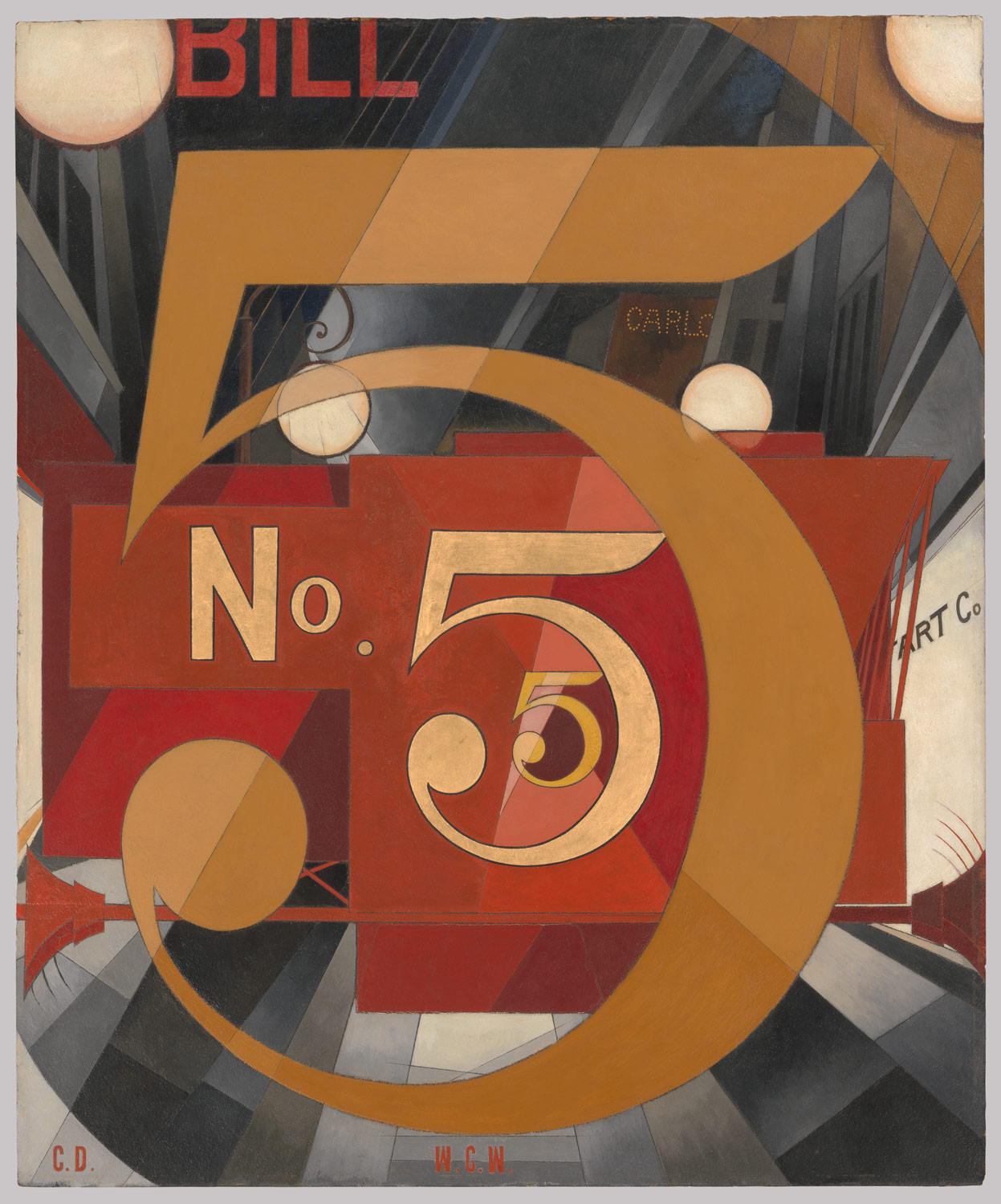
I showed Demuth's The Figure 5 in Gold and the corresponding poem by William Carlos Williams.

It reminded me how much I enjoyed the work I did in college on the Imagist poets, particularly Williams.

I love the aesthetics of vacillating between the literary line and the figurative one, and I'm fascinated by the emergence of meaning from the point where language meets visual perception. I think this is why I like Dillard so much: meaning emerges from the point where language meets biology and place--only with Dillard, the emergence is more of a transformation.

Her language does to nature what transubstantiation does to the bread and wine of the Eucharist.

12 November, 2008

Red

I keep meaning to write about my Coldplay show from last weekend, (and I even have some images to post) but I can't seem to get to it. Worse, I'll have another show tomorrow that will also be worth a post. Rats. Two behind now.

I've also been looking at those daily photos, still. It got me seeing, and I took these outside the front door of my apartment. Look! Our own fall colors!


30 September, 2008

French Fete

I am really excited about my birthday this weekend. I'm hosting a French wine tasting, which promises to be a night filled with cheesy berets, eyeliner mustaches, and something other than Chianti (my obsessive favorite).


Here are the beautiful invitations and envelopes my friend Melissa made for the event:


21 August, 2008

08 August, 2008

MFA St. Petersburg Highlights

Today my friend Anna and I finally made it to the Museum of Fine Arts in St. Petersburg, FL. It is said to be the best art gallery we have here in Florida, which isn't saying much for a theme park state. Still, the gallery boasts more than a decent cast of characters. This is my first time visiting it since their renovation and since my brief teaching foray into "art history," and both of these things made me enjoy it so much more than my last time here.

Gallery Highlights:

  • It's not ever crowded. No one is in your picture viewing space.

  • It is small, it can be thoroughly seen in a little under 2 hours.

  • Excellent, thorough curating. What makes this gallery affordable and accessible is that there are no real masterpieces in it, which is how we probably have it in Florida. Even though it is full of second and third-tier works, the explanations on the wall accompanying the work note its all its meaningful aspects AND situate the artist within the movement of its contemporaries. THEN it explains the movement and its characteristics, THEN it identifies aspects of the work that match both characteristics of the artist and movement. This approach taught novices and experts alike, while truly revealing the nature and significance of the work. I couldn't find who wrote them, but well done! to them.

  • The Ansel Adams and the American West exhibit. I have seen hundreds of reproductions of his prints but never so many made by the artist himself. The exhibit showcased 2 schools of photography. The first, founded by Adams in his club F/64, produces its its image with straight photography with little or no manipulation of contrast during printing. The other school is the pictorialist one, where images are refined and abstracted during printing and the artists' visions are revealed in the darkroom. My dad belongs to the straight photography school, who uses his engineer's penchant for math and science to shoot the exact image he wants. For me, the math and science of shooting pictures is a means to an artistic end, where my main care is in the composition of line and shape, color and form. I think I'm more Stieglitz than Adams.

  • Leon Berkowitz's Big Blue. This piece made me remember why I give any time to color field paintings. Seeing the paintings reproduced they look more like colorful geometry. Seeing them in person reveals their movement. The light and colors vibrate and play off each other. It is not that the work doesn't have any subject, it is just that it's seeking to almost objectify the abstractions of movement, energy, color, and light.


  • The lesser known pieces of the Ashcan artists. The Ashcan school was famous for its gritty urban life scenes at the turn of the 20th century. This trio here features surprising contemplation and serenity. the SPMFA has several of these kinds of lesser-known pieces that complete the viewers collective understanding of the artist. By showing these atypical pieces, the artists become more than their reputations, schools, and stigmas.


  • The American Impressionists. This is an impressionist painting of a place in Massachusetts. I love to see American examples of American things because it keeps the art I love from feeling so foreign. Impressionism does not have to be inherently tied to french nationalism.


  • The Shepherd Girl by Bouguereau. His people seem to be living, and although is this a miniture of the first version, (still painted by the original artist) it is just as moving. Bouguereau was a French Academic painter and one of the most admired critics of the 19th century. It is nice to see someone still painting in the lines during this time, and beautifully at that, rather than drowning in either absinthe or the silly lilly pond.

02 August, 2008

Walking along the Strand

One of the highlights of my recent time in London was a long walk along my blog's namesake, The Strand. Check out my tabblo of the photos from that stroll:

16 July, 2008

Favorite Things


I am working on some photos of my favorite things, which include my pen, journal, books, and coffee, but it is posing quite the photography set of problems. I am struggling with getting a wide enough depth-of-field to incorporate all of the detail I want, but still being close enough to concentrate on small scale and details. If I put everything in the same plane, there is too much emphasis on geometric simple shapes. I am also struggling with lighting and setup in my apartment. Nevertheless, here are a few shots of the shots I like so far. Any technical suggestions for my camera?


15 July, 2008

Post Secret

On Sunday, I went to the PostSecret exhibit at the Brevard County Art Museum with Jen. She is one of several I know who subscribes to the updates from the website and owns the books. PostSecret explains itself as "an ongoing community art project where people mail in their secrets anonymously on one side of a postcard."

I went because I'll go anywhere the word "exhibit" is used, but I wasn't really ready for what I experienced. The exhibit was arranged in Plexiglas so you can see the ACTUAL cards, both front and back. It is one thing to have these cards show up in my Reader feed, but these were real. Real handwriting, real tape, real photos--real people.

You who are familiar with the weekly post have read enough of these to know how twisted and horrifying these are--seeing the postcards makes all that pain real. What is more, all of that hiding is real. I am scared of the kind of pain and hiding that motivates the mailing of one of these cards. I hate feeling their pain and the pain of having to keep these things secret. I feel so much of their shame. I quit reading the Sunday Secrets a few months ago because I found them so distressing. To see the real cards magnified that horror tenfold.

On the morning I went, I had a conversation with a friend urging her not to bury painful things, and then I came to this place where I could see what people are burying. Here, the reasons NOT to bury things were illustrated. I can't imagine that the pain of hiding these things is any less than the pain that would come from being seen with your secret. In fact, I wonder how much of the pain comes from the hiding of them. Furthermore, in their hiding, dark things become so much more toxic because they can't be evaluated by the light of love and truth.

The curator for the exhibit, and Frank, the collector of the postcards, mean for there to be something meaningful and beautiful in the courage that it takes these people to share their secrets. But unless we know to whom the cards belong, it is not really sharing. These people think they are freeing their secrets, but so what? What gives the secret its power is when it is owned, or if the secret is big enough, what the Secret owns. But seeing secrets without ownership is little more than spying on someone's shame. The secret itself does not have the power to free the person who feels forced to keep it.

Frank, the project guy said, "Some of the most beautiful postcards in this collection came from very painful feelings and memories. I believe each one of us has the ability to discover, share, and grow our own dark secrets into something meaningful and beautiful." The thing is, does mailing a postcard really transform pain into something else? Could that be possible?


When I looked at the postcards, I just saw hundreds of people who were still bound to their secret and all of the circumstances that comprise the secret. Frank says that it is cathartic, that it means something to put the secret out there. But I wonder if it does? Wouldn't the anonymity that is supposed to bring liberty actually strip it of its meaning? It seems like a really false freedom.

And then I wonder: Why don't those people have someone who loves them enough to bear their secrets?

I struggled to relate to this because I rarely have the urge to hide. I think this comes from having the deep-seated belief in an omniscient God. More than this, it is a God who, in His first exchange with people in their new tainted Genesis condition, calls them out of hiding. King David says of God, "O LORD, you have searched me /and you know me...even the darkness will not be dark to you; / the night will shine like the day, /for darkness is as light to you." I find it freeing to know that nothing can be hidden from where it could matter most to hide it. It is freeing because there is perfect Love to match that omniscience.

When we left the exhibit, I felt so heavy and deeply grieved. I am glad Jen went over the bridge to the beach. As I stood there letting the water wash over my feet, and felt the cool breeze, and smelled how fresh the air, I felt the heaviness lift. It was a really serene stretch of beach.

I read someplace that beauty can heal the deepest pain, so maybe that explains it. Maybe only something as beautiful as a late-afternoon beach, (and the surprise delight of seeing dolphins) can fill and bind up the the gashes that come from going through life.

Or maybe that is nonsense.

Tides


Tides
There are some coasts
Where the sea comes in spectacularly
Throwing itself up gullies, challenging cliffs,
Filling harbours with great swirls and a flourish,
A theatrical even that people gather for
Curtain up twice daily. You need to know
The hour of its starting, you have to be on guard.

There are other places
Places where you do not really notice
The gradual stretch of the fertile silk of water
No gurgling or dashings here, no froth no pounding
Only at some point the echo may sound different
And looking by chance one sees 'Oh the tide is in.'

Jenny Joseph (b. 1932)


02 July, 2008

High Points

I was uploading some of my photos from my trip to print, and I found myself amazed at all we saw and did. I have led this trip 4 other times, and none of them were as fulfilling and fruitful as this one. So even though I have been home for a few days, I thought I would blog about the high points, city by city, before I forget them.

Rome:
Out of a dozen days in Rome, these couple were some of the very best. While in Rome, our tour guide through the Vatican took us through the Papal apartments to the Raphael rooms, which included the School of Athens. In front of the painting by Raphael of Plato and Aristotle (and Heraclitus), our guide explained Platonic epistemology to the students in terms they understood. Jen and I also identified some core teaching tendencies in the two of us, and vainly located ourselves in the painting as well. I am Plato, she is Aristotle.

I also saw the Keats and Shelley museum for the first time, which was a treat because I love the Romantics' fascination with Italy. I have often cited Keats as my favorite Romantic, (on my more stable and grounded days I say Wordsworth) and the museum at the spanish steps is the apartment where he died. The museum had a huge stack of first editions, letters, and collected works, as well as a writing desk in the place of Keats. It made me want to write odes.

Florence:
This is usually my favorite stop on the tour with the students because of the relaxed pace. There is also a tour guide there we have had three times on whom I have more than a small crush. It is always a pleasure to see Giovanni again, who taught me how to order a cappucino in Italian, showed me were the Brancacci chapel was for the Massacio frescoes, and this time showed me where to get my tickets for the Uffizi. I had never been able to get tickets to this incredible gallery, where I saw the Renaissance-era work that is my speciality. Unfortunately, they put the most notorious works behind highly protective glass. This is to keep flash photography from ruining the image in the long term, but as you can see with the light reflections, the image is ruined in a different way, anyway! The best part of this museum, though, was the way we went through it. It is a rare thing to have a companion in a gallery who travels as I do. Jen and I bought the same book, read the same information about the paintings we were seeing (in person!) as we went, and then discussed what we read and saw at the same pace! How much more I digested and kept because of this! When I see a piece of art in person, it becomes part of me, and every reproduction of it reminds me of the time I "met" it. I have never in one day "met" and known so many masterpieces, and I'll continually be delighted because these are some of the most reproduced works.


Paris:
The highlight of Paris for me was my world history lesson in the Louvre to about half of my group, including my little sister. I walked them through the Italian painting wing, and taught them about Counter Reformation art, and introduced them to DaVinci (both the Mona Lisa, and Madonna of the Rocks) and the picked up how to identify key figures based on colors and symbols, identifying which ones were divine and which ones were human. I used this for a mini theology lesson on the dual nature of Jesus. Then I took them to the French Neo-classical wing and we examined the propaganda paintings by David for Napoleon and talked about modern media and politica propganda, I used Gericault's Raft of the Medusa to teach compositional fundamentals, and I used The Oath of the Horatii and Winged Victory to teach about neoclassicim and the impact of this intellectual trend on modern democracy, natural rights philosophy, and the extension of art to the masses. At one point, I had a trail of eavesdropping strangers who thought I was giving a tour. My glee was uncontainable.

London:
We had great weather in London, making for really lovely days. I got to tour the students (myself!) around Parliament square, up through Trafalgar Square, through the theatre area to Picadilly Circus, narrating as I went. I pointed out 10 Downing St, and explained Nelson's victory over Napoleon. It was so thrilling to teach my students about my favorite city in the world. My sister said I was insuffereable, but I could not have been more delighted. Another favorite time for me was my walk with Jen along the length of the Strand, my blog's namesake, to Fleet Street. This is a picture of me crossing the Strand. I hadn't walked its full length in ages, and it is a lovely, photogenic walk that lets you commune with the literary saints and pass a free afternoon.


10 April, 2008

On Neighbors

A sage friend of mine has done a series of posts this week on Thoreau, and before commenting, I want to express my gratitude.

Not raised with a profound appreciation for the Transcendentalists (they're clever phrase-turners but wacky, self-absorbed, impractical men), I am always so delighted when someone reminds me of how good they are. I have a friend, who, for years has championed Emerson, especially his early discussions of prayer, and now I work with someone whose (invisible) daily t-shirt reads "I'd rather be at Walden." It's not only my sage friend's contemplative posts for which I am grateful, but his commitment to pursuing what is Good--and what makes him Good.

He says, " I read one of Dan Brown's books over the Christmas break--Angels and Demons. And I'll say about it what I said after reading The DaVinci Code: Dan Brown is good with suspense and plot, but he's not much of a craftsman when it comes to prose. But now, I want to add this: Did reading either of these books improve my life in any way? Did they inspire me to greatness? Did they show me any truth about my life, or about the human condition? Did they help me to understand anything about myself and my relationship to the world?

Of course, the answer to all of these questions is no.

And of course, the answer to this problem is to choose your friends wisely, and to spend time (and effort) developing the relationships in your life that matter."

I had a conversation with my little sister tonight about why we don't watch / listen to / read junk. She had tried to show me a YouTube video with a parody song for "Snakes on a Plane." It came from my brother who watches an enormous amount of TV, has only ever read 4 books, and listens to everything; sometimes it seems his only criterion is "The coarser the better." I resent his ability to mold my sister into his likeness--a poster-child for Thoreau's "underbred and low-lived and illiterate..."

With my sister, I am free to speak in terms of a common faith that I don't really share with my brother. At fifteen, she possesses a passion for truth, a desire to know God, and a human compassion that belies her age. That she might become mired in YouTube (at best) poses and urgent crisis--one that makes me examine my drive to "find the art in everything." With Megan, I could easily say, "We avoid this stuff because God tells us to," and her concern for living rightly wouldn't need much more of an explanation. But she deserves more than that--we both do--as YouTube and "Will.I.Am" threaten to devour her.

I think about giving her Thoreau, but I remember I have something a little more meaningful. While I am so pleased by the excerpt from Thoreau that reminds me how to live rightly, I forgot I already had excerpts that practically teach us to do this.

We pursue Homer, Michelangelo, Madison (Federalist Papers), and Haydn because we are directed to:

St. Paul urges the Philippians, "Finally, brothers, whatever is true, whatever is noble, whatever is right, whatever is pure, whatever is lovely, whatever is admirable—if anything is excellent or praiseworthy—think about such things... And the God of peace will be with you."

Also, he urges the Thessalonians, "Test everything. Hold on to the good. Avoid every kind of evil."

While I put these verses in my brain in something like 5th grade, I only recently saw freedom and direction in them.I am stuck here at how relevant the specific passages of the bible are. (I probably wouldn't have been so startled by this, but I have spent the last 6 months or more wrestling with a paralyzing practical agnosticism worthy of a dozen posts.)

I was raised with a contempt for the Trancendentalists because their humanism and "Oversoul" theology is out of line with my God-centered, spiritually specific one. But I need to read Plato. I need to read Madison. I need to read Donne and Dostoyevsky. I need to read these because they are right and noble and excellent, even if we aren't in perfect agreement. Thoreau's pursuit of meaningful neighbors is meaningful to me.

Here is what startled me: I am meant to be, by tradition and habit, odds with Thoreau, while the Thoreauvians are at even greater odds with traditional Christian teachings. Yet, they match!

I am free to read everything and only keep what is good. And I am not just free, I am required to. Herein lies an even great direction for living rightly.

Shortly before Jesus is crucified, he fervently prays for his disciples in the upper room, "My prayer is not that you take them out of the world but that you protect them from the evil one. They are not of the world, even as I am not of it. Sanctify them by the truth; your word is truth. As you sent me into the world, I have sent them into the world. For them I sanctify myself, that they too may be truly sanctified."

Those who follow Christ are meant to be in the world, but not of it--quite the familiar Christian phrase.

It is in pursuit of this ideal--being in the world but not being a part of it-- that has us pursuing genuine touchstones of culture in order to guard against the toll taken by YouTube and Snakes on a Plane. We stay away from things that anchor us IN the world that are of it. We fill our lives with what is good because only this reflects the true nature of our God.

Those familiar with the directions of the Bible recognize that we follow them not because we fear judgment if we don't, but because they are what brings true life and peace.

Thoreau criticizes society because its complications and materialism do not bring life. This is not new to Christians, it is orthodoxy.

And this leaves the distinct possibility that the path to sanctification is through Walden's woods.

15 March, 2008

Old World Florida

Because of my sister's wedding, my spring break plans were in the air for a long time--which, as all procrastination does, resulted in me going nowhere.

This is particulary troubling because I get antsy from living in the wrong place. It is not that my apartment is wrong, or my state is wrong, it is that I am wholly convinced my continent is wrong. Those who know me well agree that I should have been born European.

And if I can't live in Europe, I need to at least be in a city that affords high culture and art. Through and through, I am a city girl--which is about the opposite from where I live and work.

For months I have been craving a city fix, so Spring break was crucial.

In spite of being grounded to Florida, and all of its theme-park superficiality, thanks to a good, gourmet friend, I have had quite the Old-World week, including yesterday.


  • On Monday we went to the Vatican exhibit and had authentic Spanish food.
  • Tuesday was a languid day including a Siesta.
  • Wednesday, we wandered around downtown Orlando (not much of a city to speak of, but still tall buildings) with a glamourous lunch and cocktail-dress shopping.
  • Thursday I met a friend for coffee and we sat outside Starbucks, cafe style, people watching and drinking coffee, enjoying the weather for hours. (If I was fixed enough on my friend and the poetry we were reading, I could maybe forget it was Hwy 50 behind me)

And Friday was my most European day--We spent the the whole day Gourmet shopping, then I cooked a fabulous Italian dinner. My purchases yesterday include:

--Crème fraîche
--Deep, Italian-Roast coffee
--Extra-Sharp, aged English cheddar cheese
--Greek chicken to cook for dinner
--Rome baking apples
--Fresh Romano cheese
--Mille Course-ground Dijon
--Baguette
--Basil plant
--a bottle of Carpineto Dogajolo
--a bottle of Tuscan Chianti that had a picture of Carvaggio's Bacchus.
--Banfi Rosa Regale

I had a great lunch, courtesy of Fresh Market, of a cranberry chutney, gouda, and turkey sandwhich, with Salt and Vinager crisps and Orangina!

For dinner I used my romano cheese to make a red-pepper sauce. (I sauteed the peppers in red wine with a few cloves of garlic then put it all in a blender with the cheese and screme fraiche) I put the sauce on the greek chicken and handmade QuattroFromaggio tortelli (courtesy of Fresh Market) and we have a feast!

For being stuck in Orlando, it sure was an Old World week.

11 March, 2008

Pontiff-icating.

Yesterday we took the girls, Punya and Amirah, over to St. Pete for a cultural day out. It was a little rushed, and the gallery for which we were aiming was closed, but we had a nice lunch at Columbia, and instead went to the Florida International Museum, known for its rotating exhibits.


The exhibit on display was called Vatican Splendors, and it was billed as "Michelangelo items and works by Bernini, Giotto, and others. Artwork dating back to the third century. From the venerated relics (bone fragments) of Saint Peter to items from the election of Pope Benedict XVI, this exhibit comprises one of the largest Vatican collections ever to tour North America. Many items have never before been on public view...", which sounded like a decent alternative to the closed Museum of Fine arts.

But that curation of the exhibit was not what we were expecting. As art and history scholars, we were surprised at how much of the exhibit concentrated on religious Catholicism and the authority of the pope. I got the impression we were supposed to revere the artifacts in the exhibit much more than we actually did. The commentary on the pieces left room for them to be imbued with their supernatural powers. Instead of the scholarship we were expecting, we encountered a strange, superstitious medievalism--and this was difficult to overcome. The exhibit was not meant for people who had not familiarity with Catholic ritual and dogma, and I think this caused us to lose the brown girls.


I found myself wishing it were more secularized so it could be universally accessible. Ironically, the meaning of the word "catholic" is universal, but it was precisely the "Catholicism" that made it less universal. And still, it is the Catholicism, as opposed to protestantism, that gave what would have been a fully religious exhibit its historic, artistic, geographic, and sociological significance. Only the Catholic church had the resources to offer these artifacts for public consumption.


Even for a non-religious person, there is no denying the significance of the Vatican. It has the greatest concentration of masterpieces in the world--an unsurpassed amount of beauty and history. The Vatican, as the world's smallest principality, has profoundly shaped the history of the world for 1000 years--arguably the greatest impact of any nation, individual, or religion in history. And this is just at an organizational level. It neglects the role of religion in general as one of the most powerful shaping forces in history (for better or worse). Furthermore, in modern times, the Pope is the leader of an estimated 1 billion people. No other individual exerts such influence. Regardless of religious overtones, any insight into this organization is a worthy exhibit context.


Beyond context, the exhibit displayed some really fun things. For art lovers, we saw a mosaic by Giotto, a Disney-fied recreation of the Sistine Chapel ceiling workshop, the compass Michaelangelo used for his frescoes, a clay study of Bernini's David, and documents signed by Bernini, Bramante, and Michaelangelo. For History's sake, the exhibit had Etruscan and Greek statues; a portrait of Nero; excavation demos, revealing preserved catacombs and tombs under the Vatican; and, more recently, the documents, sample ballots, and actual white-smoke cannister from the election of the current pope in 2005.


Most intresting to me, was the detailed history of the building and space of what is now St. Peter's Basilica. Constantine built the first basilica on the site of what was believed to be the tomb of St. Peter, an important Christian claim. The exhibit discussed the Vatican excavations in the 1950's and 1960's of the area beneath the modern St. Peter's. Archeology revealed remains in tombs in this area from exactly the time of St. Peter's purported crucifixion. While limits on science prevent the specific identity of the remains from being determinable, it still situates remains in the exact place claimed by Christian tradition. Most important, science and archeology, the two things most capable and most probable for disproving ancient Christian claims, are unable to do so. Herein lies the difference between this religion and superstition. Superstition is a set of rules and behaviors extrapolated from limited human experience that defies historical knowledge and scientific law. It also can never be validated by science, but it can easily be disproved.

Just like human experience, the limits on science and archeology prevent it from proving the veracity of the supernatural. Based solely on human observation, time limits their field of view. However, what is impossible in one age may be said to be impossible in all human ages. That the remains beneath the basilica are still possibly those of St. Peter leaves room for one day's improved science and archeology to verify the claims of the bible and the surrounding documents. Conversely, improved science and archeology may disprove it one day, but all reliance on future determination requires a degree of faith.

The location of St. Peter's basilica also points to another significant Constantinian tradition--the first Basilica was a product of his "miraculous conversion." We believe the motivation for the Basilica's construction due to an account by Eusebius, widely considered to be the best source history has on Constantine. Eusebius' account contains a detailed claims regarding the life and work of this 4th century ruler, which have been verified by archeology and other contemporary documentation. But it also contains unverifiable material explaining Constantine's sight of divine direction. This presents supernatural skeptics with a difficult dilemma: Do they accept the document as valid, despite its supernatural claims, or do they reject it and its historical usefulness based purely on their own bias against the supernatural? C.S. Lewis says no:
"We find that accounts of the supernatural meet us on every side. History is full of them--often in the same documents we accept wherever they do not report miracles... No doubt most stories of miracles are unreliable; but then, as anyone can see by reading the [news]papers, so are most stories of all events. Each story must be taken on its own merits: what one must not do is rule out the supernatural as the one impossible explanation."
For the brown girls, maybe the exhibit fell victim to unfamiliarity and the tension between history and the supernatural, or maybe it was teenage boredom combined with encountering hostile old people. But it's extraordinary that we had 17yr-olds who were willing to go at all, instead of doing what other girls their age do on Spring Break. No matter the retention, the exposure was still a good thing. If anything, I hope they get a chance to learn earlier than most that no matter how foreign or boring a thing may seem, one should take hold of it, because every chance to learn is an opportunity for a richer life experience, if not immediately then eventually.